
Kenmore Washing Machine Not Filling With Water | Causes & Repair Tips
If your Kenmore washer displays an "NF" (No Fill) error and won't take in water, the cause almost always falls into one of three groups: something is blocking water from reaching the machine, the inlet valve or its screens are clogged or failed, or the pressure/sensor system that tells the washer "water is present" isn't working correctly. Left unaddressed, this typically ends with the inlet valve solenoid burning out completely at which point a simple clean-and-check job becomes a part replacement.
Quick Answer: Why Won't My Kenmore Washer Fill With Water?
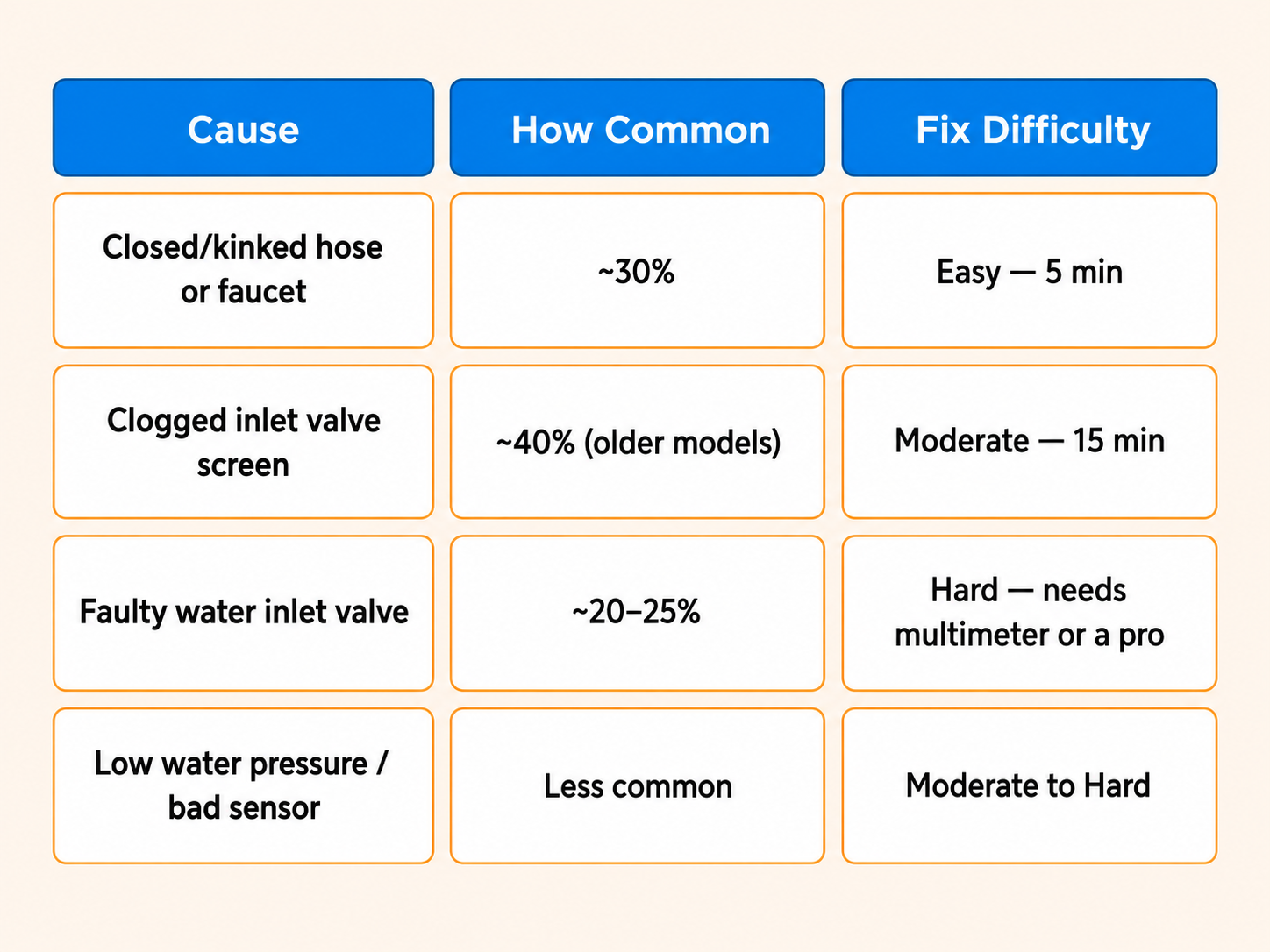
A Kenmore washer won't fill because one of three systems has failed: the water supply path (closed/kinked hoses, low pressure), the inlet valve (clogged screens or a failed solenoid), or the pressure/level sensor that confirms water is entering the drum. In our technicians' experience working on Kenmore washers across the Boston area, hose and faucet issues are the most common starting point to rule out, followed by clogged or failed inlet valves, with sensor faults being the least frequent but hardest to diagnose without tools.
Does Your Kenmore Model Matter? (100, 500, and 700 Series)
Kenmore doesn't manufacture its own appliances the brand licenses its name to Whirlpool, LG, and occasionally other manufacturers depending on the series, and the internals differ accordingly.
100 Series models are typically Whirlpool-built. The inlet valve and screens are usually accessed from the back panel, and parts are widely available.
500 Series washers are also generally Whirlpool-based but may include additional sensor wiring for water-level detection, so double-check the air hose connection to the pressure switch before assuming the valve itself has failed.
700 Series and higher-end Kenmore Elite models are more often LG-manufactured, with electronic water-level sensors instead of a purely mechanical pressure switch — meaning a "no fill" symptom on these can sometimes be a control board communication fault rather than the valve itself.
If you're not sure which series you have, it's printed on the model/serial tag, usually inside the door frame (front-load) or under the lid (top-load).
Top-Load vs. Front-Load: Does It Change the Fix?
Yes, in two ways:
Top-load Kenmore washers usually have a single combined inlet valve assembly at the back, feeding a mechanical pressure switch through a small air dome hose. This hose is the single most common point of failure on top-loaders a pinhole crack or a bit of trapped water in the loop will cause a no-fill or under-fill symptom that looks identical to a valve failure.
Front-load Kenmore washers typically use a dual or triple-solenoid inlet valve (for cold, hot, and sometimes a separate detergent-dispenser line), and rely more often on an electronic water-level sensor rather than a pressure switch. If only one solenoid has failed, you may still get a partial fill — a full no-fill on a front-loader more often points to a control board fault or a completely failed valve assembly rather than a single clogged screen.
Why Does the NF Error Happen Even When Faucets Are Open?
The NF error triggers when the washer doesn't detect water flow within the first few minutes of a cycle — and this can happen even with both faucets fully open, because the washer isn't checking whether the faucet is open, it's checking whether water is actually reaching the drum through its own supply line. Manually pouring water into the drum doesn't help either, for the same reason the fill sensor only recognizes water entering through the intended path.
The Three Real Causes, One at a Time
1. Water Supply Path (Hoses and Faucets)
This is the fastest thing to rule out and, in our experience, resolves the largest share of no-fill calls. Hoses kink, develop small internal cracks, or get compressed if the washer has been pushed too close to the wall. A partially closed shutoff valve sometimes turned during unrelated plumbing work is another common, easy-to-miss cause.
2. Inlet Valve and Screens
Small mesh screens inside the inlet valve catch sediment from your home's water supply. Over years of use, especially in older Kenmore units, these screens accumulate enough buildup to choke off flow even when water pressure at the wall is normal. If the screens are clean but the washer still won't fill, the valve's solenoid itself may have failed electrically this doesn't clean out, it needs to be tested and typically replaced.
3. Pressure Switch and Water-Level Sensor
This system tells the washer how much water has entered, and if it malfunctions, the washer may refuse to fill at all rather than risk overflowing. A cracked, pinched, or waterlogged air hose between the tub and the pressure switch is the most common failure point on mechanical (top-load) systems. On newer electronic sensor systems, a wiring fault or control board issue can produce the same symptom.
How to Test Your Water Pressure at Home
Low pressure (typically below 20 psi at the washer's connection) can prevent a fill even when every component is working correctly. To check it yourself:
Disconnect the fill hose from the back of the washer.
Turn the water valve on briefly and check the strength and steadiness of the flow into a bucket — a weak, inconsistent stream suggests a pressure or supply-line problem rather than a washer fault.
If you have a hose-bib pressure gauge (available at most hardware stores), attach it directly to the shutoff valve and take a reading. Household water pressure should typically read between 40–80 psi; readings under 20 psi at the washer connection point to a supply-side issue, not the machine itself.
If pressure is low only at the washer but normal elsewhere in the house, the shutoff valve itself may be partially closed or failing.
DIY Fixes: What to Check Before Calling a Technician
1. Check the water supply and hoses. Confirm both hot and cold faucets are fully open. Inspect hoses for kinks, bends, or leaks even a minor twist can cut off enough pressure to trigger the NF error. Replace any damaged hose immediately.
2. Clean the inlet valve screens. If water is reaching the washer but it still won't fill, remove the inlet screens and rinse them under running water; soaking in vinegar helps clear stubborn sediment. Reinstall carefully. If the washer still won't fill, the valve's solenoid may need testing with a multimeter for continuity.
3. Inspect the pressure switch air hose. Check the hose connecting the tub to the pressure switch for cracks, loose fittings, or trapped water, and replace if needed.
A few safety notes before you start: turn off the water supply and unplug the washer before touching anything, take photos of hose and wire connections before disconnecting them, and keep towels nearby in case of spills during testing.
How to Reset a Kenmore Washer After an NF Error
Once you've addressed the underlying cause, most Kenmore models can be reset the same way:
Unplug the washer (or switch off the breaker) for 60 seconds.
Close and reopen both water shutoff valves fully.
Plug the washer back in and open the lid/door twice within 12 seconds if your model requires the standard Whirlpool-style reset sequence (check your model's manual, as this varies by series).
Start a short test cycle without clothes to confirm it fills normally before running a full load.
If the NF error returns immediately after a reset, the underlying fault hasn't actually been resolved that's the point to stop troubleshooting and call a technician rather than repeating the reset.
When Should You Stop DIY and Call a Technician?
If your washer still shows the NF error after checking hoses, faucets, inlet screens, and the pressure switch hose, the remaining possibilities a failed solenoid, a bad pressure switch, or a control board fault require a multimeter and some electrical know-how to diagnose safely. Attempting to test or replace these without the right tools risks further damage or an electrical hazard.
If you've worked through the steps above and the NF error persists, call (781) 666-9565 our technicians can diagnose and fix the exact cause the same day in most cases.
Promix Appliance Repair: Same-Day Kenmore Washer Service
A washer that won't fill can throw off your whole laundry routine, and Kenmore owners across the Boston area count on Promix to get it running again the same day. Promix Appliance Repair services all major Kenmore models, and for no-fill problems specifically, our certified technicians handle:
Inlet valve testing and replacement
Pressure switch and water-level sensor diagnostics
Full-system checks to rule out compounding issues, like a fill problem alongside a drain problem
Serving your area: we provide same-day Kenmore washer repair across Newton, Needham, Brookline and the surrounding Greater Boston area.
Protect your laundry routine and avoid a small valve issue turning into a full replacement. Call Promix today at (781) 666-9565 to schedule fast, dependable Kenmore washer repair — most appointments booked early in the day can be seen the same afternoon.
Frequently Asked Questions
Is it safe to test or replace the water inlet valve myself?
If you're comfortable using a multimeter and following manufacturer safety steps, testing the solenoid for continuity is usually safe. Replacing the valve itself involves working near electrical and water connections if you're not confident, it's safer to call a technician.
How long does a typical Kenmore washer repair take?
Most inlet valve, pressure switch, or sensor repairs are completed in a single same-day visit once the technician has confirmed the exact cause.
Can a no-fill error damage my washer if I ignore it?
The NF error itself won't cause water damage — that risk comes from drain or overflow problems, not a fill problem. What ignoring an NF error does risk is the inlet valve solenoid burning out completely, turning a simple clean-and-test job into a full part replacement.
Do you repair other Kenmore appliances besides washers?
Yes our technicians repair Kenmore refrigerators, dryers, dishwashers, and stoves, ovens, and ranges across the Greater Boston area.
Why does my Kenmore washer show NF even though I just filled it manually?
The fill sensor only recognizes water entering through the washer's own supply line, not water added directly to the drum. If NF persists after a manual fill, the fault is still in the hose, valve, or sensor path.

