
Most Common LG Washing Machine Mechanical Issues and How to Fix Them
At Promix, our technicians repair LG washers across Greater Boston every week, and the ten failures below are ranked by how often we actually see them in the field — not by theory. Drum bearing and shock absorber issues alone make up the majority of the LG washer service calls we handle in the Newton, Brookline and Needham area.
Owning an LG washing machine usually means reliable, efficient performance — but even well-engineered appliances develop mechanical problems over time. Constant vibration, water exposure, and heavy load cycles gradually wear down internal components, and when one part fails, it often puts stress on others nearby.
Understanding the most common LG washing machine mechanical issues helps you catch problems early, avoid unnecessary repair costs, and make a smarter decision about whether to repair or replace. This guide covers 10 of the most frequent mechanical failures our technicians see in LG washers, what causes each one, how to diagnose it at home, and what a professional repair realistically involves.
If your LG washer is making noise, shaking, refusing to drain, or stopping mid-cycle, one of the problems below is almost certainly the cause.
1. Drum Bearing Failure — The Roaring or Rumbling Noise
What it sounds like: A loud roaring, grinding, or rumbling sound during the spin cycle — many homeowners describe it as a "jet engine" coming from the laundry room.
What causes it: Water gradually seeps past the rear tub seal and reaches the drum bearings. Once moisture penetrates, the bearings corrode and lose their ability to support the drum smoothly. This is one of the most common LG front-load washer mechanical problems and one of the most important to catch early.
How to diagnose it at home:
Open the washer door and rotate the drum slowly by hand
A healthy drum spins smoothly and quietly
A failing bearing feels rough, stiff, or wobbly, and may produce a grinding sensation even at slow speed
Try lifting the front of the drum slightly — any noticeable play or looseness confirms bearing wear
What the repair involves: Drum bearing replacement is one of the more involved LG washer repairs. The outer tub typically needs to be fully disassembled to access the bearing assembly. On many LG models, the bearing and tub seal are sold as a kit and replaced together — replacing the bearing without the seal is a short-term fix since the same leak that caused the original failure will recur.
Why it matters: Ignoring worn bearings leads directly to spider arm failure (see below), which turns a $200–$350 bearing job into a $400–$700+ drum assembly replacement. This is the one LG washer mechanical problem where delaying repair actively makes the eventual bill larger.
2. Spider Arm Failure — The Repair That Shouldn't Wait
What it is: The spider arm (also called the drum spider or rear drum support) is the three-pronged metal bracket that connects the inner drum to the main drive shaft. It's made from a die-cast aluminum alloy that, on many LG models, is vulnerable to corrosion from detergent residue and moisture.
What causes it: High-efficiency detergent overuse, combined with water retained in the tub, creates an alkaline environment that corrodes the aluminum arms over time. Spider arm failure is almost always a downstream consequence of ignored drum bearing wear — once the bearing fails and the drum starts wobbling, the extra stress fractures the spider arms.
Symptoms:
Loud banging or clunking during the spin cycle (louder and more sudden than bearing noise)
Visible cracks or breaks on the metal arms when you look through the door
Drum that spins unevenly or catches
Glass door cracking in severe cases from drum contact
What the repair involves: Spider arm replacement requires complete drum disassembly. The inner drum must be removed, the broken spider arm detached from the rear shaft, and a new unit installed. On LG models where the tub is welded rather than bolted, this repair can approach the cost of a new machine — which is why your technician should assess the tub condition before committing to this repair on an older washer.
3. Shock Absorber Wear — Violent Shaking During Spin
What it sounds like: The washer shakes violently, bangs against walls or cabinetry, or physically moves across the floor during spin cycles.
What causes it: LG washers use two or four shock absorbers (dampers) positioned between the outer tub and the base frame to control drum movement during high-speed spins. These wear out gradually — typically after 5–8 years of regular use — and once they lose their damping ability, the drum swings freely at spin speeds.
How to diagnose it at home:
First, confirm the washer is level — use a spirit level across the top of the machine and adjust the feet until all four corners make firm contact with the floor
If leveling doesn't reduce the shaking, open the machine (front panel on front-loaders, cabinet on top-loaders) and visually inspect the shock absorbers
A healthy shock absorber offers firm resistance when compressed by hand
A failed one compresses easily with little or no resistance, or shows visible oil leaks, cracks, or separation at the mounting points
What the repair involves: Shock absorber replacement is a moderate repair — parts are typically $15–$40 each, and labor involves removing the front or rear panel to access the mounting points. Most LG models require replacing all absorbers at the same time rather than just the visibly failed one, since they wear at similar rates.
At-home steps to try first:
Redistribute the laundry load — unbalanced loads mimic shock absorber failure symptoms
Reduce load size — consistently overloading accelerates absorber wear
Check that all four feet are firm on the floor with no wobble
Related Topic: Mechanical problems aren’t always the cause. Some LG washer issues are linked to system alerts and digital faults, which are explained in detail in Common LG Washer Error Codes.
4. Door Boot Seal Tears — Leaks and Drum Contact
What it is: The door boot seal (also called the door gasket or bellow) is the rubber accordion-fold seal that runs around the inside of the door opening on front-load LG washers. It keeps water inside the drum during the wash cycle.
What causes it: Small items left in pockets — coins, bra underwires, keys, hair clips — pass through during the wash and become trapped in the fold of the gasket, where they gradually cut or puncture the rubber. Mold buildup weakens the rubber over time, especially if the door is kept closed between washes. On older seals, the rubber simply hardens and cracks with age.
Symptoms:
Water pooling on the floor in front of the washer during or after a cycle
Visible tears, holes, or black mold growth on the rubber seal
A grinding or scraping noise if a foreign object is caught in the seal and making contact with the drum
How to diagnose it at home:
Run a short cycle and watch the door seal area for any water seeping out
After the cycle, dry the seal thoroughly and inspect the entire surface, including the inner fold, for tears, cracks, or embedded objects
Pull the fold of the gasket back gently and check the inner groove for coins or debris
What the repair involves: Door boot seal replacement is one of the more straightforward LG washer mechanical repairs — the old seal is peeled away from the front panel and drum, and the new one is stretched and seated using the retaining springs or wire clamps depending on the model. Parts cost $30–$90 depending on the LG model. Labor is the majority of the cost since full access requires removing the front panel on most LG front-loaders.
5. Drain Pump Failure — The OE Error Code
What it shows: The OE error code on your LG display means the washer cannot drain within the expected time window. The cause is almost always mechanical — either a clogged filter or a failed pump motor.
Step 1 — Check and clean the drain filter first:
Locate the small access panel on the bottom front of your LG washer
Place a shallow pan or towel under it before opening — water will come out
Turn the filter cap counterclockwise and pull it out
Clean debris thoroughly — coins, lint, and small clothing items are the most common culprits
Reinsert and run a drain cycle to test
Step 2 — If cleaning doesn't resolve it:
Listen to the washer during the drain phase
A functioning pump makes a consistent humming sound as it moves water
A pump that hums loudly but doesn't drain water suggests the impeller is jammed
A pump that makes a grinding noise indicates internal wear
A pump that makes no sound at all has likely failed electrically or mechanically
What the repair involves: Drain pump replacement on LG front-loaders typically requires tilting the machine back or removing the front panel to access the pump housing. The pump itself costs $25–$60 for most LG models. This is a repair most competent DIYers can handle with the right part and a YouTube guide for their specific model, or a straightforward professional job that usually takes under an hour.
6. Motor Coupling Failure — Washer Won't Spin or Agitate
What it is: On LG top-load washers with direct-drive systems, the motor coupling is a plastic and rubber connector between the motor and the transmission. It's intentionally designed as a sacrificial part — when the washer is overloaded, the coupling breaks instead of the motor or transmission.
Symptoms:
Washer fills with water but won't agitate or spin
Motor hums but nothing moves
Burning rubber smell during operation
No error code displayed (the machine thinks it's running normally)
How to diagnose it at home:
Unplug the washer and remove the cabinet (the motor coupling is located between the motor and the transmission on the underside)
Inspect the coupling visually — a broken coupling will show visible cracking, separation, or missing rubber sections
What the repair involves: This is one of the best-value LG washer repairs — the part itself costs $10–$20, and replacement involves removing the motor and sliding the new coupling into place. A technician can complete this in 30–45 minutes. The important note: if the coupling broke due to consistent overloading, it will break again unless load habits change.
7. Stator or Rotor Failure — Direct Drive Motor Problems
What it is: LG front-load washers use a direct drive motor system — a stator (fixed winding) and rotor (rotating magnet ring) that work together to spin the drum without a belt. This is one of LG's signature engineering features, but both components can fail mechanically.
Symptoms:
LE error code on the display (motor error)
Washer starts then stops shortly into a cycle
Drum struggles to spin or spins slowly
Loud humming with little drum movement
Burning smell from the motor area
Common mechanical causes:
Foreign objects (coins, wire, small items) falling between the drum and tub, entering the rotor area and jamming the motor
Hall sensor failure (a small sensor on the stator that monitors rotor position)
Rotor magnet damage from physical impact
Stator winding damage from moisture or overheating
How to diagnose it at home:
An LE code combined with a drum that moves briefly then stops is the strongest indicator
Unplug the washer and check for any obvious foreign object debris by rotating the drum slowly by hand and listening for resistance
What the repair involves: Stator and rotor access requires removing the rear panel on most LG front-loaders. The rotor unbolts with a single center bolt. Inspect for physical damage and foreign objects before replacing components. A hall sensor replacement is the cheapest fix ($15–$30). Full stator replacement runs $80–$150 in parts. This is a repair best handled by a technician since incorrect reassembly of the rotor bolt torque can cause secondary failures.
8. Lid Switch or Door Lock Assembly Failure — Machine Won't Start or Mid-Cycle Stops
What it does: The lid switch (top-loaders) and door lock assembly (front-loaders) are safety mechanisms that prevent the washer from running with the lid or door open. When they fail mechanically, the washer either won't start at all or stops mid-cycle as the machine incorrectly reads the door as open.
Symptoms:
Washer won't start despite powering on normally
dL or door lock error codes
Cycle stops suddenly mid-wash with no other error
You can hear the door lock mechanism attempting to engage (clicking) but the cycle won't begin
Door physically won't release after a cycle
How to diagnose it at home:
Listen for the click of the door lock engaging when you start a cycle — no click at all suggests a failed actuator
Inspect the door latch strike (the plastic or metal tab on the door that engages the lock) for cracks or misalignment
On top-loaders, the lid switch is located under the lid — a broken plastic tab on the lid that should depress the switch is a common and easily visible failure
What the repair involves: Door lock assembly replacement is a relatively simple repair on most LG front-loaders — the assembly is typically accessible from inside the door opening after removing the boot seal retaining ring. Parts cost $20–$60. Lid switches on top-loaders are even simpler to access. This is one of the more DIY-friendly LG washer repairs if you're comfortable with basic disassembly.
9. Water Inlet Valve Failure — Washer Won't Fill or Fills Slowly
What it is: The water inlet valve is the electronically-controlled mechanical valve that opens to allow hot and cold water into the drum. It has internal mesh screens that filter sediment from the water supply, and a solenoid mechanism that opens and closes the valve during each cycle.
Symptoms:
Washer takes much longer than normal to fill
IE error code (inlet error — washer not filling within the expected time)
Washer fills with only cold or only hot water regardless of cycle setting
Washer won't fill at all
Water continues to trickle into the drum when the machine is off (a failed-open valve — turn off the water supply immediately if this occurs)
How to diagnose it at home:
First, check water supply — confirm both hot and cold supply valves behind the washer are fully open
Check the inlet hose screens — disconnect the hoses from the back of the washer (with the water off) and inspect the small mesh screens at each inlet port for sediment buildup; these can be cleaned with a toothbrush
If the screens are clear and supply pressure is normal but the problem persists, the valve itself has failed
What the repair involves: Inlet valve replacement is straightforward — the valve is typically located at the rear of the machine where the hoses connect, secured by a few screws. Parts cost $25–$60. The repair takes 20–30 minutes and is manageable for a careful DIYer or quick for a technician.
10. Tub Seal Failure — The Source of Most Long-Term Mechanical Problems
What it is: The tub seal sits between the outer tub and the rear bearing, preventing water from reaching the drum bearing. It is arguably the most important seal in the entire machine — when it fails, water enters the bearing housing, which starts the chain reaction that leads to bearing failure, then potentially spider arm failure.
Symptoms:
Rust-colored water or staining on laundry
Water dripping from the bottom rear of the machine
Drum bearing noise (the downstream consequence of a failed tub seal)
Musty or metallic smell from the washer
Why this matters strategically: Tub seal failure is rarely the presenting problem — it's the hidden root cause that shows up later as bearing noise or spider arm breakage. When a technician replaces drum bearings on an LG washer, the tub seal should always be replaced at the same time. Replacing bearings without the seal is the equivalent of patching one hole in a boat while leaving another open.
What the repair involves: Because the tub seal is located at the rear of the drum assembly, replacing it requires the same full disassembly as a drum bearing job — the two repairs are almost always done together. If you're told you need a bearing replacement, confirm the tub seal is included in the scope of work.
LG Washer Mechanical Problems: When to Call a Technician
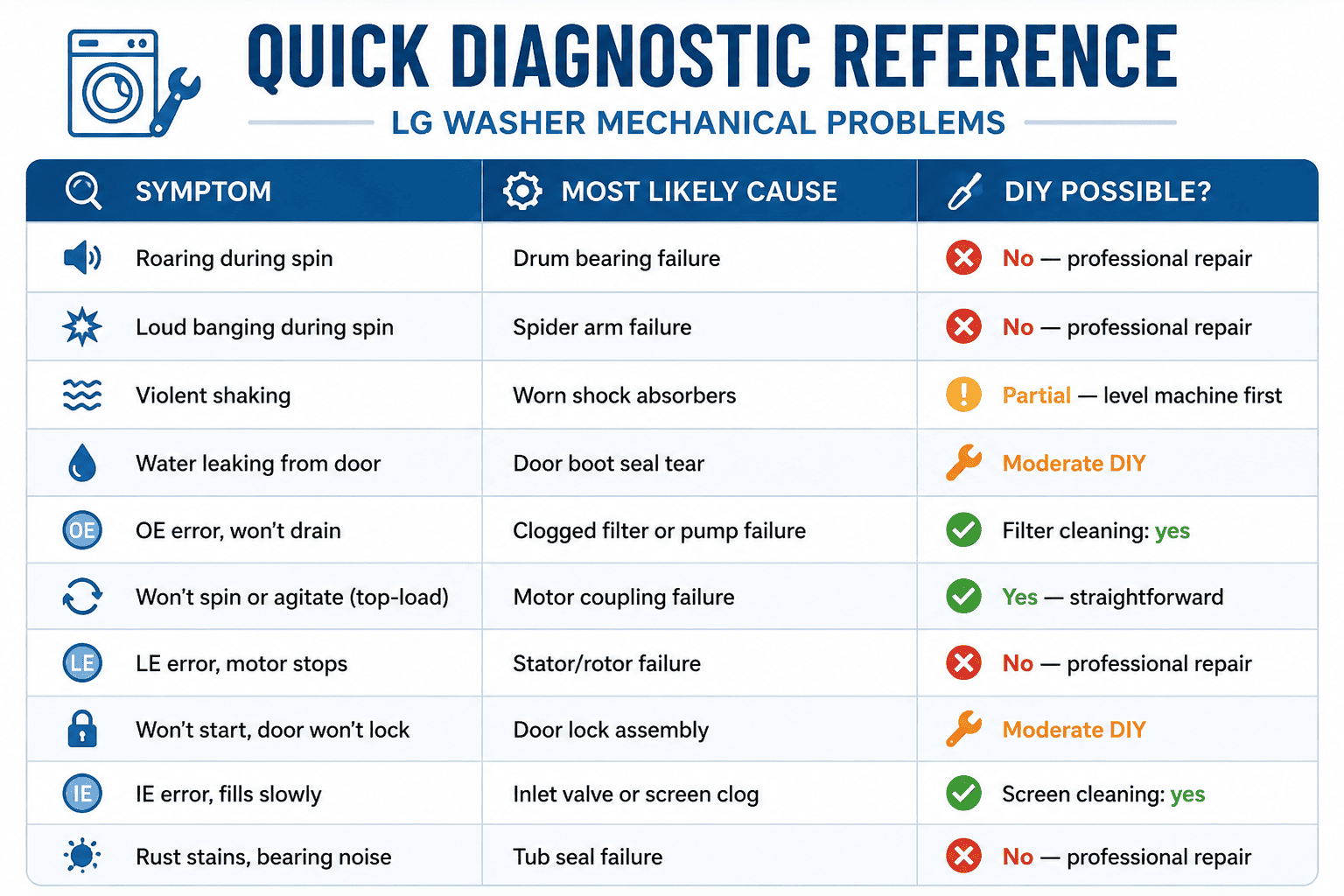
Some of the issues above — inlet valve screens, door lock strikes, drain filter cleaning — are genuinely manageable for a careful homeowner with basic tools and a model-specific guide. Others, specifically drum bearings, spider arms, stator/rotor, and tub seal replacement, require full disassembly of the outer tub, specific torque specs, and reassembly knowledge that makes professional repair the practical path for most people.
The financial benchmark worth knowing: if the cost of repair exceeds 50% of what a comparable replacement washer costs, replacement is usually the smarter financial decision. For most of the repairs above, you're well under that threshold — drum bearing repair on a 5-year-old LG washer is almost always worth doing; the same repair on a 12-year-old machine with a cracked spider arm and a corroded tub may not be.
If your LG washer is showing any of the symptoms above and you're in Newton, Needham, Brookline, or anywhere across Greater Boston, Promix offers same-day diagnosis. Our technicians will inspect the machine, identify the exact failure, and give you an honest repair-vs-replace assessment before any work begins.
Call (781) 666-9565 or book online for same-day LG washer repair in Greater Boston.
Frequently Asked Questions: LG Washer Mechanical Problems
What is the most common mechanical problem with LG washing machines?
Drum bearing failure is the most frequent mechanical issue we see in LG front-load washers, typically presenting as a loud roaring or rumbling noise during the spin cycle. It's caused by water leaking past the tub seal and corroding the bearing housing over time.
How do I know if my LG washer drum bearing is failing?
Rotate the drum slowly by hand with the door open. A failing bearing feels rough or gritty rather than smooth, and may produce a grinding sensation even at low speed. A roaring noise specifically during the spin cycle that gets louder over time is the classic sign.
Can I still use my LG washer if the bearing is noisy?
For a short time, yes — but not long. A noisy bearing is a bearing that is actively destroying itself and the surrounding components. If left running, it will progress to spider arm failure and potentially crack the outer tub, turning a $250–$350 repair into one that may cost more than a new machine.
What does the OE error code mean on an LG washer?
OE means the washer failed to drain within the expected time. Start by cleaning the drain filter (bottom front access panel). If the filter is clear and the error persists, the drain pump has likely failed and needs replacement.
What does the LE error code mean on an LG washer?
LE is a motor error — the drive motor has overloaded or stalled. Common causes include a foreign object jamming the rotor, a failed hall sensor, or a worn stator. Unplug the machine and check for debris before assuming the motor itself needs replacement.
Why does my LG washing machine shake so violently during spin?
The most common causes are worn shock absorbers (the dampers that control drum movement at high speeds) and an unlevel machine. Check leveling first — if all four feet are firm and the machine is still shaking, the shock absorbers need replacement.
Is it worth repairing an LG washer or should I replace it?
For most mechanical failures on a washer under 8–10 years old, repair is the financially sound choice. The exception is spider arm failure or outer tub damage on an older machine, where the repair cost can approach the cost of a new unit. A Promix technician will give you an honest assessment before recommending any work.
How long do LG washing machines typically last?
With regular maintenance and prompt attention to early warning signs, LG washing machines typically last 10–14 years. Drum bearings are often the limiting component — catching bearing wear early and repairing it promptly is one of the best ways to extend the life of the machine.

