
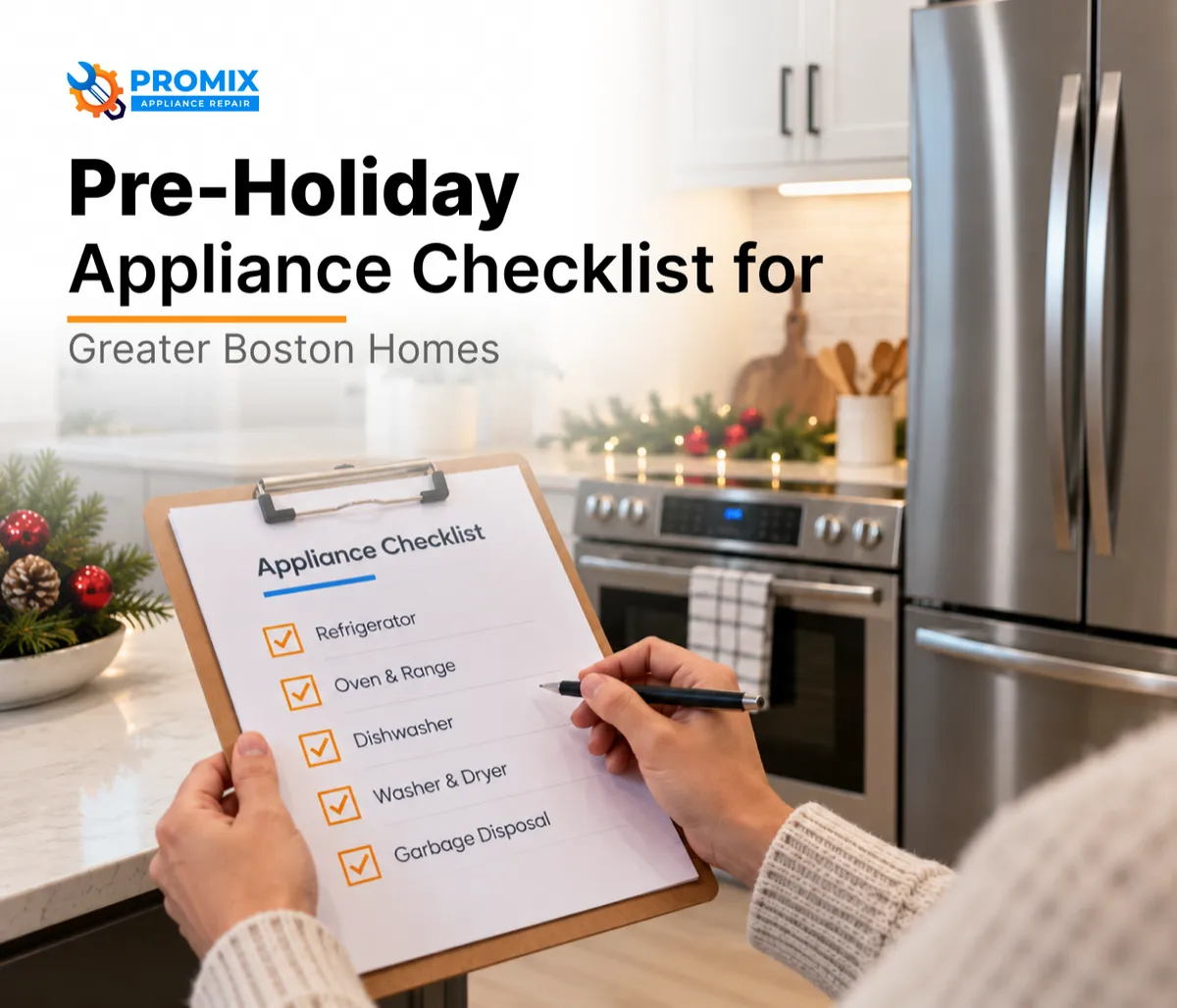
Pre-Holiday Appliance Checklist for Greater Boston Homes
Quick answer: Two to three weeks before you host, test every appliance the way you'll use it on the day. Run the oven for 30 minutes with a thermometer inside, and skip self-clean in the last two weeks. Put appliance thermometers in the fridge (40°F or below) and freezer (0°F). Clean the dishwasher filter and keep grease, peels and skins out of the disposal. Clean the dryer's lint screen and check the outside vent flap. Make sure your smoke and CO alarms work. Anything that fails, book the repair before Thanksgiving week, when parts and appointments get tight.
Between Thanksgiving on November 26 and New Year's, a Greater Boston kitchen does more work than it does in the previous three months. The oven runs for six hours instead of forty minutes. The fridge holds a 20-pound bird and three days of leftovers. The dishwasher runs twice a night, and the washer and dryer handle guest sheets and towels.
Most of what I repair in late November didn't break suddenly. It was already weak, and the holiday load found it. A fridge that ran a little warm in October can't keep up when the door opens all day Thursday. A dryer vent that was half-clogged becomes a real problem with four extra loads of linens.
This is the checklist I'd run in my own house. It's organized by appliance, with the honest line on what you can do yourself and what needs a technician, and a dated timeline at the end you can print and stick on the fridge.
Why the Holidays Are Hard on Boston-Area Appliances
Three things stack up here that don't in a mild climate.
The load. Thanksgiving is the single busiest cooking day of the year, and the numbers show it. The NFPA estimated 1,446 home cooking fires on Thanksgiving Day 2023, 388% above an average day (NFPA via KRVN). Plumbers feel it the next morning: Roto-Rooter says the day after Thanksgiving is its busiest of the year, with calls up 50% over a normal Friday, mostly kitchen sinks and disposals (Roto-Rooter).
The cold. Late November is when the second fridge in the garage or the freezer on the back porch starts acting up. A cold room is not a favor to a refrigerator, as I explain in the fridge section below.
The houses. A lot of homes in Newton, Brookline, Belmont and Wellesley were built long before anyone imagined a double wall oven, an induction cooktop and a beverage fridge on the same wall. Older kitchens often have fewer circuits, so running the roaster, mixer, coffee urn and microwave at once is a real way to trip a breaker at the worst moment.
1. Oven, Range and Cooktop
The oven is the appliance that ruins the day if it fails, so it gets checked first and earliest.
Run a 30-minute temperature test. Hang an oven thermometer on the middle rack, set Bake to 350°F, wait 10–15 minutes after the preheat beep, then read it every 5 minutes for half an hour. Ovens normally swing about 25°F either way; it's the average that matters (America's Test Kitchen). Off by up to 35°F, most digital ovens let you recalibrate. More than that, have the sensor tested.
Try every mode you'll use. Bake, broil, convection, the second oven, the meat probe, the warming drawer. A part can fail quietly in a mode you only use once a year.
Don't self-clean in the last two weeks. Self-clean runs around 800–900°F for hours, and that's when weak thermal fuses, door locks and control boards give out. If you want it clean, run it by Nov 8, or clean by hand.
Pull foil off the oven floor. On most newer electric ovens the bake element is hidden under that floor. GE's manual warns foil there traps heat and can melt into the enamel (GE manual).
Test-fit your roasting pan. If it nearly touches the oven walls, air can't circulate and the bird cooks slowly. USDA lists an oversized pan as one reason roasting runs long (USDA FSIS).
Light every gas burner. Each should catch within a few seconds with a blue flame. If one clicks but won't light, dry it, reseat the cap and clear the ports.
Check the door gasket. Close the door on a dollar bill at a few spots. If it slides out with no drag, heat is leaking.
For deeper troubleshooting, see our guides to an oven not heating before Thanksgiving and a gas burner clicking but won't light.
2. Refrigerator and Freezer
The fridge fails quietly. Nobody notices it's running at 44°F until the cream smells off on Thursday morning.
Put a thermometer in both sections. The FDA's targets are 40°F or below in the fridge and 0°F in the freezer, and it notes that few fridge controls show the real temperature (FDA). USDA's trick for an accurate fridge reading: set the thermometer in a glass of water on the middle shelf and aim for 38–40°F (USDA FSIS). For the freezer, tuck it between frozen packages.
Clean the condenser coils. They're under the front kick plate or on the back. Dust on the coils makes the compressor run longer and hotter, which is exactly when an aging one fails. Unplug first, then vacuum with a brush attachment.
Dollar-bill test on both door gaskets. A weak seal on a door that opens all day lets warm, moist air in, which shows up as frost on the back wall and a fridge that can't hold temperature.
Don't overpack. The FDA warns cold air has to circulate around food to keep it chilled. A turkey thawing on the middle shelf plus three days of leftovers can block the vents between the freezer and fridge on many models.
Plan the leftovers. Hot food won't damage the fridge, but split it into shallow containers so it cools fast, and get it in within two hours (FDA).
Run the ice maker now. If it hasn't made ice in weeks, discard the first two batches and check the bin fills. Buying bags of ice on Wednesday is easier than a repair on Thursday.
The garage fridge problem
This one is specific to New England. That second fridge in the garage or on the enclosed porch works fine all fall, then the food in its freezer starts to thaw around the first hard freeze.
It sounds backwards. AHAM, the appliance manufacturers' association, explains why: most fridge-freezers take their cue from the fresh-food side. In a cold room that side stays cold on its own, so the compressor runs less, and below about 38°F it may not run at all. The freezer then warms toward room temperature and the food thaws. AHAM says that unless a unit is designed for it, it shouldn't sit somewhere that falls below 60°F (AHAM).
If your holiday overflow fridge lives in the garage, put a thermometer in its freezer the week before, and check your manual for its minimum room temperature. Some models are sold as garage-ready; most aren't.
3. Dishwasher, Disposal and Sink
The sink side of the kitchen is what breaks on Friday, after the guests leave and the grease has had a night to set.
Clean the dishwasher filter. Most dishwashers made in the last decade have a manual filter under the bottom rack that twists out. A clogged one causes standing water, gritty dishes and slow draining. Rinse it under the tap with a soft brush.
Run a test cycle and check it drains. If water sits in the bottom afterward, clean the filter again and check the drain hose under the sink for kinks. See our guide to a dishwasher not draining.
Spin the spray arms. They should turn freely. Clear clogged holes with a toothpick.
Keep grease, skins and starch out of the disposal. Roto-Rooter's holiday list: never pour grease, turkey drippings or oil down the drain, and keep potato peels, poultry skin, bones, rice and pasta out of the disposal (Roto-Rooter). Wipe greasy pans with a paper towel before they go in the dishwasher, too.
Run the disposal before you need it. Run cold water first, keep it on while the disposal runs, and feed scraps gradually. If it hums but doesn't spin, turn it off; it's jammed.
Don't stack dishwasher and disposal back to back. On many sinks they share the same drain. Run the disposal, let it clear, then start the dishwasher.
4. Washer and Dryer
Guests mean sheets, towels, tablecloths and napkins, often run back to back in one afternoon. That's hard on a dryer, and it's where the real fire risk is.
Clean the lint screen every load. NFPA data puts failure to clean as the leading factor in home dryer fires, about a third of them, with lint and clothing the items that most often ignite first (NFPA fact sheet).
Check the outside vent flap. Run the dryer on air-only and go outside. You should feel strong airflow and see the flap open. Weak airflow means lint in the duct. Clean the full vent at least once a year, or sooner if loads take longer than they used to.
Look behind the dryer. A crushed foil duct or one with a sharp kink chokes airflow. Rigid or semi-rigid metal duct, kept short and straight, is far better.
Don't overload with bedding. A queen comforter plus sheets in one load stays damp in the middle, so it runs longer and hotter. Split it.
Clean the washer gasket and run a cleaning cycle. Front-loaders trap water and lint in the door boot. A cleaning cycle with a washer cleaner a week before guests stops the musty smell on fresh towels. More in our post on why a washing machine smells.
Check the hoses. Look for bulges or cracks in the washer's fill hoses. A burst hose with a house full of people is a bad day.
If your dryer already takes two cycles to dry a load, read dryer takes too long to dry clothes before the holidays, not after.
5. Range Hood, Microwave, Alarms and Circuits
Soak the range hood filters. Grease-loaded mesh filters cut airflow and are a fire risk above a busy cooktop. Soak them in hot water with dish soap or a degreaser, or run them through the dishwasher if your manual allows.
Test the hood on high. With a gas range cooking for hours and a full house, you want the hood moving air. If it's loud but weak, the filters or the duct are the likely culprit.
Test smoke and CO alarms. Press the test button on each one. If you have a gas stove, gas heat, a fireplace or an attached garage, Massachusetts' Nicole's Law requires CO alarms on every level of the home, and within 10 feet of bedroom doors on sleeping levels (Mass.gov). Guests sleeping in a finished basement or attic count.
Check the microwave door and turntable. A microwave that runs but heats weakly, sparks or makes a loud buzz should be retired from holiday duty until it's checked.
Map your kitchen circuits. Plug in the electric roaster, the coffee urn and the slow cooker the week before and see which outlets share a breaker. Spread them out on Thursday.
Write down model numbers. Snap a photo of the model and serial sticker on each major appliance. If something fails on a holiday weekend, a technician can check parts before the visit.
The Countdown: What to Do When (Thanksgiving = Thu, Nov 26, 2026)
Print this one. The goal is to find every problem while there's still time to fix it.
When | What to do |
Week of Nov 2 | Self-clean the oven if you must (last safe window). Clean fridge coils and the dryer vent. Write down model numbers. |
Week of Nov 9 | Oven 30-minute thermometer test; try every mode. Thermometers into fridge and freezer. Test smoke and CO alarms. |
Week of Nov 16 | Book repairs for anything that failed. Clean the dishwasher filter and hood filters. Check the garage fridge's freezer temperature. |
Mon–Tue, Nov 23–24 | Pull foil off the oven floor. Make room in the fridge for the thaw. Run a washer cleaning cycle and wash guest linens. |
Wed, Nov 25 | One normal oven preheat. Light every burner. Run the dishwasher empty so it starts Thursday clean. |
Thu, Nov 26 | Food thermometer in the turkey (165°F). Grease into a can, not the sink. Leftovers into shallow containers within two hours. Run the dishwasher and disposal one at a time. |
Fri, Nov 27 | Check the fridge thermometer after Thursday's door traffic. Clean the lint screen between every linen load. |
For Christmas and New Year's, repeat the oven test and the fridge thermometer check in early December, and clean the dryer lint screen and hood filters again after Thanksgiving's workout.
Frequently Asked Questions
What should I check on my appliances before hosting Thanksgiving?
Test the oven with a thermometer for 30 minutes, confirm the fridge is at 40°F or below and the freezer at 0°F, clean the dishwasher filter, clean the dryer lint screen and check the outside vent, and test smoke and CO alarms. Do it two to three weeks ahead so there's time for repairs.
How far ahead should I check my appliances?
Two to three weeks before the holiday. Common parts arrive fast, but control boards and premium-brand parts can take several days, and repair schedules fill up the week before Thanksgiving.
What temperature should my fridge and freezer be?
The FDA recommends 40°F or below for the refrigerator and 0°F for the freezer. Use a separate appliance thermometer, because most built-in controls don't show the actual temperature.
Can I keep a second fridge in an unheated garage over the winter?
Only if it's built for it. Most fridge-freezers stop running properly when the room gets cold, and the freezer section can thaw. AHAM advises against placing standard units where the temperature drops below 60°F. Check your manual's minimum room temperature.
Should I self-clean my oven before Thanksgiving?
Not in the final two weeks. Self-clean heats the oven to roughly 800–900°F, which is when weak fuses, door locks and control boards tend to fail. Clean by hand or run self-clean by early November.
How do I avoid a clogged disposal on Thanksgiving?
Keep grease, turkey drippings, potato peels, poultry skin, bones, rice and pasta out of it. Run cold water before, during and after, feed scraps slowly, and don't run the dishwasher at the same time.
Do I need CO alarms if I have a gas stove in Massachusetts?
Yes. Under Nicole's Law, homes with fossil-fuel equipment such as a gas stove, furnace or water heater must have CO alarms on every level, and within 10 feet of bedroom doors on sleeping levels.
The Bottom Line
Holiday appliance failures are mostly predictable. Weak parts fail under heavy load, and the fix is to apply that load early, on your schedule, while there's still time for a part. Run the checklist in early November, fix what fails, and the holiday weeks become a lot calmer.
If anything on this list fails, Promix Appliance Repair serves Newton, Brookline, Needham, Wellesley, Waltham, Lexington and the rest of Greater Boston, often the same day when the schedule allows. Call (781) 666-9565, 7:30 a.m. to 7:00 p.m., seven days a week. Our service call fee is credited toward the repair if you go ahead, and repairs are warrantied on parts and labor. See the full list of towns on our service area page.
About the author
Jack is a certified appliance repair technician at Promix Appliance Repair with more than 10 years of hands-on experience. He repairs ovens, ranges, refrigerators, dishwashers, washers and dryers across Newton, Brookline, Needham and Greater Boston, from GE, Whirlpool, Samsung and LG to Sub-Zero, Wolf and Miele. Late November is his busiest stretch of the year.

