

Dishwasher Leaving White Residue? Here's Why and How to Fix It
Key Takeaways:
White residue on dishes is almost always caused by hard water minerals, but an empty rinse aid dispenser, the wrong detergent, or water that's too cool can leave the same cloudy film.
The fingernail test sorts a fixable problem from a permanent one: if the film scrapes off it's removable residue, but if it won't budge, the glass is etched and can't be reversed.
Hard water is the single most common cause a vinegar or citric-acid rinse cycle clears most buildup, and a whole-house water softener fixes it permanently.
Keeping the rinse aid dispenser full, switching to a gel or pod detergent built for hard water, and not overfilling the detergent compartment resolve most chemical causes.
Wash water that isn't hot enough (below 120°F) and a dirty filter or clogged spray arm can both leave residue by preventing proper rinsing.
If hard water, rinse aid, detergent, filter, and water temperature are all ruled out and residue persists, the cause may be mechanical like a failing heating element or water inlet valve and needs professional diagnosis.
Custom HTML/CSS/JavaScript
If your dishwasher is leaving white residue on dishes and glasses, hard water minerals are almost always the culprit — though an empty rinse aid dispenser, the wrong detergent, or a wash cycle that's too cool can leave the same cloudy film. The good news is there's a 30-second test that tells you which one you're dealing with, and most causes clear up with things you already own.
A dishwasher leaving white residue is one of those problems that looks the same from every angle but has several different roots, and treating the wrong one wastes a lot of vinegar and patience. Before you run another cycle, it helps to know exactly what you're looking at because one version of this "residue" isn't residue at all, and no amount of cleaning will fix it.
The Fingernail Test: Residue or Etching?
This is the fastest way to sort a fixable problem from a permanent one, and it takes less time than reading this paragraph.
Take a glass with the white film on it and run your fingernail across the cloudy area.
If the film scrapes off (even partially, even with some effort), you're dealing with mineral deposits or detergent buildup sitting on top of the glass. This is fixable, and everything below in this guide applies to you.
If your fingernail glides right over it and nothing comes off, the cloudiness is baked into the glass itself. That's etching microscopic damage to the surface of the glass, not a coating sitting on it.
Etching is permanent, and no dishwasher setting, detergent, or repair will reverse it. Soft water and repeated exposure to aggressive detergent are the usual causes over years of use, and it mostly affects older or lower-quality glassware. Once it starts, the only real move is prevention on the glasses you have left more on that further down.
If your dishwasher is leaving white residue that fails the fingernail test on your favorite wine glasses, the disappointing truth is those glasses are done — but it also means your dishwasher itself is very likely working fine. Everything from here on assumes the residue passed the test and is actually removable.
Quick Diagnosis: Match the Symptom to the Cause
Before you start troubleshooting, this table narrows it down in a few seconds. Find the row that matches what you're seeing, then jump to that cause below.
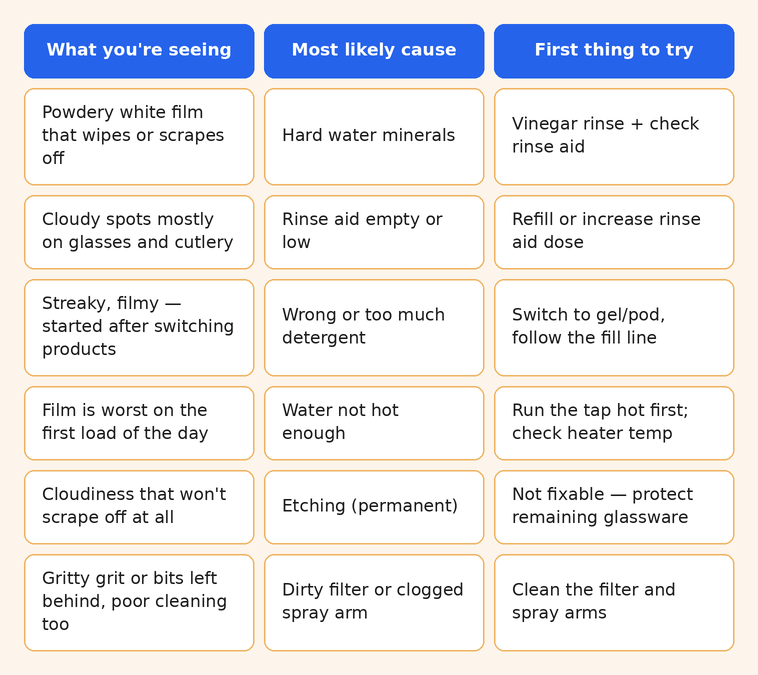
If more than one row sounds familiar, that's normal — these causes often stack. Work through them top to bottom and you'll clear the biggest offenders first.
Cause 1: Hard Water Mineral Buildup
This is the single most common reason a dishwasher is leaving white residue, and it's a water-supply issue rather than an appliance defect. Hard water carries dissolved calcium and magnesium. When your dishwasher heats water during the wash and dry cycles, those minerals don't evaporate — they're left behind on every surface the water touched, including your dishes, the tub walls, and the heating element.
You can usually confirm hard water is the cause by checking a few other spots around the house:
Chalky white buildup around your faucet aerators or showerheads.
A grayish-white crust forming inside the dishwasher tub itself, especially around the door seal and lower rack.
Spots that look powdery rather than greasy or streaky.
Soap that never seems to lather well, and a filmy feel on shower doors.
Want to be certain? Inexpensive water-hardness test strips (a few dollars at any hardware store) give you a number in grains per gallon. Anything above roughly 7 gpg is considered hard, and above 10 gpg you'll be fighting residue on nearly every load. Many local water utilities also publish their average hardness online.
If any of that sounds familiar, hard water is very likely why your dishwasher keeps leaving white residue no matter how carefully you load it.
Cause 2: Rinse Aid Is Empty or Not Dispensing
Rinse aid does two jobs: it helps water sheet off dishes instead of forming droplets, and it prevents minerals in those droplets from drying into visible spots. Without it, hard water residue gets noticeably worse — even water that isn't especially hard can leave spotting once the rinse aid runs dry.
Check the rinse aid compartment next to the detergent dispenser. If the indicator shows empty or low, that alone can explain a dishwasher leaving white residue even in a home with only moderately hard water. If it's full but the residue persists, the dispenser cap or dosage wheel may be stuck or set too low — most machines let you increase the dose in small increments, and bumping it up one level is a quick, free test before you assume something's broken.
A few extra things worth knowing about rinse aid:
"All-in-one" pods aren't always enough. Many pods include a rinse-aid component, but the dose is fixed and often too small for hard water. Adding dedicated liquid rinse aid on top is fine and usually helps.
A dispenser that never seems to empty may have a failed cap or seal. If the level hasn't dropped after several loads, the dispenser likely isn't releasing at all — that's a repairable part.
Cause 3: Using the Wrong Detergent (or Too Much)
Detergent chemistry changed significantly over the past decade when phosphates were phased out of dishwasher detergents nationwide. Phosphate-free formulas are gentler on the environment but noticeably worse at fighting hard water on their own, which is part of why residue complaints became more common industry-wide — not just with any one brand of dishwasher.
A few detergent-related habits also make a dishwasher leave white residue that has nothing to do with your water supply:
Using powder detergent in hard water — powder tends to leave more visible film than gel or pod formats, since it doesn't dissolve as evenly, especially in cooler water.
Overfilling the detergent compartment — more soap doesn't mean cleaner dishes; it often means more residue left behind when it can't fully rinse away.
Using dish soap instead of dishwasher detergent — this creates excess suds and a filmy residue that's a different problem entirely (and can also trigger error codes on some machines by overflowing the tub).
Storing detergent in a humid cabinet — powder and pods that have absorbed moisture clump and dissolve poorly, leaving grit and film behind.
Switching to a gel or pod-style detergent marketed for hard water, and following the exact fill line rather than "eyeballing it," solves this cause for most households within a wash or two. If you're not sure which to buy, our roundup of the best detergents for hard water covers what actually holds up against calcium and magnesium.
Cause 4: Wash Water Isn't Hot Enough
Detergent and rinse aid both depend on adequately hot water to activate and rinse cleanly. If your home's water heater is set below 120°F, or if the dishwasher is on the first cycle of the day and pulling in lukewarm water from cold pipes, minerals and detergent residue don't fully rinse away — they just get redistributed and dry onto the dishes.
Two easy checks:
Confirm your water heater is set to at least 120°F (most manufacturers recommend 120–140°F for dishwashers specifically).
Run the kitchen sink hot for a few seconds before starting the dishwasher, so it's pulling hot water from the very first fill rather than the cold water sitting in the line.
If your machine has a "high-temp wash," "sanitize," or "boost" option, turning it on for a few cycles is a good way to confirm temperature is the issue — if the residue clears with the hotter setting, you've found your answer. A film that's always worst on the first load of the day and better on later loads is a classic sign that lukewarm incoming water, not your detergent, is the real problem.
Cause 5: A Dirty Filter or Clogged Spray Arm
This one is easy to overlook because it usually shows up alongside another symptom: dishes that come out both filmy and not fully clean, sometimes with gritty bits redeposited on them. Over time, food debris, grease, and mineral scale collect in the bottom filter and in the tiny holes of the spray arms. When water can't circulate and spray freely, it can't rinse residue away — so minerals and detergent just settle back onto whatever's in the racks.
Pull out the bottom rack and check two things:
The filter (usually a twist-lock cylinder in the tub floor). Rinse it under hot water and scrub gently with an old toothbrush. Most manufacturers suggest doing this monthly.
The spray arms. Spin them by hand — they should turn freely. Hold each one up to the light and check the spray holes for scale or debris; a toothpick or straightened paperclip clears blocked jets.
The Quick Fix: A Vinegar Rinse Cycle
For residue that passed the fingernail test, this single cycle clears the majority of cases:
Empty the dishwasher completely. No dishes, no racks removed — just an empty tub.
Add white vinegar. Place a dishwasher-safe cup or bowl of white vinegar (about one cup) on the top rack, upright so it doesn't spill during the wash.
Run a hot, normal cycle — skip the heated dry option for this run.
Wipe down the door seal and tub walls afterward with a damp cloth to catch loosened mineral crust before it redeposits.
If a dishwasher was leaving white residue purely from mineral buildup, this alone often makes a visible difference on the very next full load.
For stubborn or long-neglected cases, a dedicated dishwasher cleaner works better than vinegar because it's formulated for scale. Citric-acid-based products are especially effective against limescale on the heating element and tub walls. Run one monthly to keep buildup from re-accumulating between vinegar cycles. You can also sprinkle a little citric acid powder or a cup of baking soda across the tub floor before a hot empty cycle as a between-cleans refresh.
How to Stop It From Coming Back
A few adjustments prevent most of these causes from recurring:
Keep the rinse aid dispenser full and check it every few weeks rather than waiting for the indicator to flash empty.
Switch to a gel or pod detergent built for hard water if powder hasn't been cutting it.
Run a citric-acid or vinegar cleaning cycle monthly, even when residue isn't visibly a problem yet — prevention is far less work than a full descale after months of buildup.
Clean the filter and check the spray arms monthly so water keeps circulating freely.
Confirm your water heater stays at 120°F or above, especially if you've recently changed settings to save energy.
Consider a water softener if your home tests as moderately-to-very hard and you're fighting this issue every single load.
Protecting Glassware From Etching
Since etching can't be reversed, the goal is to keep it from starting on the glasses you still love:
Don't over-dose detergent — excess detergent in soft or softened water is one of the leading causes of etching.
Skip the pre-rinse-and-heavy-cycle combo on lightly soiled loads; a gentler cycle uses less aggressive chemistry.
Hand-wash delicate or vintage glassware rather than trusting it to repeated hot cycles.
If you have very soft or softened water, dial detergent down to the minimum that still cleans well — soft water needs far less than the fill line suggests.
Brand-Specific Notes
A few manufacturer quirks are worth knowing if you own one of these brands specifically:
Bosch dishwashers rely heavily on rinse aid for their condensation-drying system (they don't use an exposed heating element the way many other brands do), so an empty rinse aid dispenser causes more visible spotting on a Bosch than on most competitors. If you're chasing residue on a Bosch dishwasher, check rinse aid first. For model-specific issues, see our Bosch dishwasher repair guide.
Samsung dishwashers with a built-in water softener setting let you dial in your local water hardness in the settings menu — if that's set too low for your actual water hardness, residue builds up even though nothing is technically broken. This is a common miss on Samsung installs; our Samsung dishwasher repair guide walks through where to find the setting.
LG dishwashers flag persistent hard water buildup through their diagnostic error codes rather than just leaving visible film, so if you're also seeing an error code alongside residue on an LG dishwasher, it's worth checking both at once. Our LG dishwasher repair guide and our dishwasher error code reference can help you decode what it's telling you.
If your dishwasher's drain is also acting up alongside the residue — standing water, slow draining, or a musty smell that's a separate issue covered in our guide on a dishwasher drain clogged.
When It's Not Just Hard Water
If you've run the vinegar cycle, refilled the rinse aid, switched detergents, cleaned the filter, and confirmed your water heater temperature — and a dishwasher is still leaving white residue — the cause may be mechanical rather than chemical. A failing heating element won't get water hot enough to activate detergent properly regardless of the setting, and a worn wash arm or spray nozzle can leave certain dishes under-rinsed even in an otherwise normal cycle. A water inlet valve that's failing can also let in too little water, so there's never enough volume to rinse residue away.
These aren't user-fixable the way a rinse-aid refill is, and diagnosing them usually requires opening the unit to test the heating element and water flow directly.
When to Call a Professional
Call a technician if you've ruled out hard water, rinse aid, detergent, filter, and water temperature, and the residue persists — or if it's paired with dishes that still feel greasy, a dishwasher that's not draining fully, or unusual noise during the cycle.
Dishwasher Leaving White Residue: FAQ
Why is my dishwasher suddenly leaving white residue when it never did before?
A sudden change usually means something ran out or changed — an empty rinse aid, a switch to a different detergent brand, or a change in your water heater's temperature setting. It's less commonly a sign of hard water getting worse overnight, since water hardness changes gradually, not suddenly.
Is white residue on dishes from the dishwasher dangerous?
No — mineral residue from hard water is not harmful to eat off of. It's a cosmetic and taste issue (it can make water and drinks taste slightly off), not a food-safety concern.
Will vinegar damage my dishwasher?
No, an occasional vinegar rinse cycle is safe for the tub, seals, and most components. Avoid using it every single cycle indefinitely, as very frequent acid exposure can wear rubber gaskets faster over years of use — monthly is plenty for most homes.
How do I know if it's hard water or my detergent causing the residue?
The fingernail test tells you if it's removable residue at all. From there, check if buildup is also appearing around your faucets and showerheads (points to hard water) versus only appearing on dishes and only since you switched products (points to detergent).
Can a water softener fix a dishwasher leaving white residue for good?
In most cases, yes. A whole-house water softener removes the minerals before they ever reach the dishwasher, which resolves residue caused by hard water permanently rather than managing it cycle by cycle.
Can I use citric acid instead of vinegar?
Yes, citric acid is often more effective against limescale and is the active ingredient in many commercial dishwasher cleaners. Run a tablespoon or two in an empty hot cycle, or use a citric-acid cleaning tablet monthly.
Why is only my glassware cloudy while plates and bowls come out fine?
Glass shows mineral film and early etching far more visibly than ceramic or plastic. If the film scrapes off it's still just residue; if it doesn't, the glassware is beginning to etch and should be hand-washed going forward.
Should I pre-rinse my dishes to avoid residue?
Usually no. Modern detergents are designed to cling to food particles, and spotless pre-rinsed dishes can actually lead to over-sudsing and more film. Scrape off solids, but let the detergent do its job.

