
Gas Stove Burner Won't Light? Start Here
Key Takeaways
A gas stove burner won't light for one of four everyday reasons far more often than anything serious: a clogged igniter port, moisture on the igniter, a burner cap sitting slightly off-center, or a gas supply hiccup.
Cleaning the igniter and burner ports with a dry toothbrush, seating the cap flat, and checking whether your other burners light will get most kitchens cooking again — no service call needed.
Clicking but no flame means the spark can't reach the gas. Clean and fully dry the ports and igniter tip, then reseat the burner cap level.
Only one burner out? The fault is local to that burner. Swapping the cap and grate from a working burner is the fastest way to prove it.
No clicking at all points to dead batteries, a loose igniter wire, a faulty spark module, or a tripped GFCI — not a gas problem.
If you smell gas, stop. Turn off the knob, ventilate, avoid any spark or switch, and never relight over and over.
The Quick Answer
There are few things more aggravating than standing over the stove, click-click-clicking a burner that just won't catch while a pan of oil waits and dinner slips later and later. Take a breath — a gas stove burner that won't light is rarely a broken stove. Almost every time, it comes down to one of four small, fixable things: a clogged igniter port, a little moisture left on the igniter, a burner cap knocked slightly off-center, or a hiccup in the gas supply. Grab a dry toothbrush, clean the igniter and the burner ports, sit the cap down flat, and check whether your other burners still light. That alone gets most kitchens back in business, no technician required.
If you've already tried that and the burner's still cold, stay with me — the rest of this guide walks through every scenario, from a single stubborn burner to a whole stove that won't light, plus the one situation (a gas smell) where you should stop troubleshooting and get help right away.
Table of Contents
Safety note before you touch anything
Quick diagnosis: match the symptom
The clicking-but-not-lighting problem
One burner won't light (but others work fine)
No clicking sound at all
Gas smell with no flame — what to do
Electric ignition vs. standing pilot: different fixes
Cleaning routine that prevents this long-term
When it's time to call a professional
Local repair help in Newton, Needham & Brookline
1. Safety First: Read This Before Troubleshooting
Natural gas and propane are safe when handled correctly, but a few rules matter every single time a gas stove burner won't light:
If you smell gas at any point, stop immediately, turn off the burner knob, ventilate the room, and don't touch anything that could create a spark (light switches included).
Never use an open flame — a lighter or match — to "help" a burner that isn't sparking. It hides the real problem and raises the risk of a flare-up.
If you've tried lighting a burner more than three or four times with no luck, stop and let any built-up gas clear before you try again.
With that out of the way, let's get into the actual fixes.
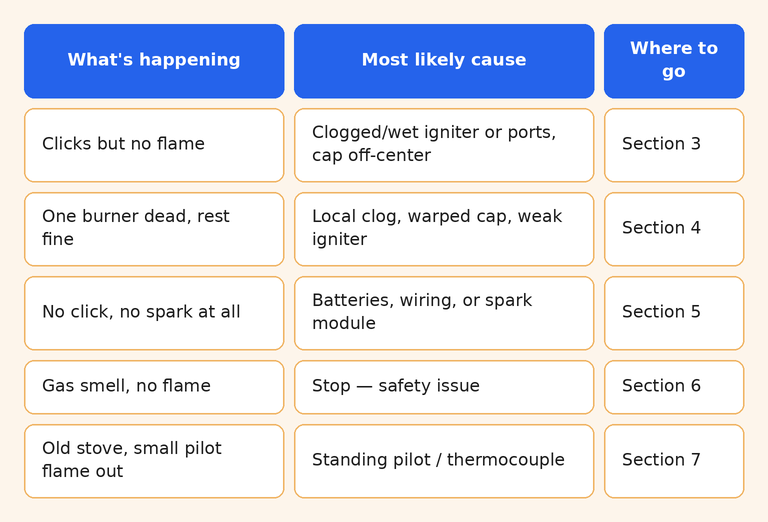
2. Quick Diagnosis: Match the Symptom
Use this to jump straight to your situation.
If the burners light fine but the oven itself runs hot, cold, or uneven, that's a different animal — see our guide to common gas oven problems.
3. Gas Stove Clicking But Not Lighting
This is the complaint we hear most, and the explanation is usually a relief. That clicking is the igniter doing its job — throwing a spark — but something is keeping the spark from meeting the gas.
Work through these in order:
Lift off the burner cap and grate and inspect the little holes around the burner head. These ports clog easily with food debris, boiled-over liquid, or plain grime, and even one blocked hole can stop ignition.
Dry everything completely. A recent spill, some condensation, or a wipe-down with a wet cloth can leave moisture on the igniter electrode, and that shorts the spark before it ever reaches the gas. Let the burner air-dry 15–20 minutes, or coax it along with a hairdryer on low.
Clean the igniter tip — the small ceramic-tipped electrode next to the burner. If it's caked with grease or residue, go over it gently with a dry toothbrush or a cotton swab dipped in rubbing alcohol, then let it dry fully.
Reseat the burner cap. Even slightly off-center or upside down, the gas won't route correctly no matter how strong the spark. It should sit flush and level every time.
If a gas stove burner won't light even with clean, dry parts and a healthy-sounding click, the igniter itself may be cracked or failing electrically. A cracked ceramic igniter often still clicks but sends the spark off to the wrong spot — that's a replacement part, and you can get a sense of what to budget in our guide to the cost to fix an oven or range.
4. Only One Burner Won't Light (Others Work Fine)
When a single burner is the holdout, the problem is almost always local to that burner rather than the stove's gas supply or main board — which actually makes life easier:
Swap the cap and grate from a working burner onto the problem one. If it lights, the original cap was warped, clogged, or misaligned.
Study the affected burner's ports under good light — one clogged hole can be invisible until you tilt it toward a window.
Compare the click. If that burner's igniter clicks slower or softer than its neighbors, that specific igniter is losing strength.
Check the igniter wire for looseness — years of vibration can slowly work a connector loose.
5. No Clicking Sound At All
Press the knob and hear nothing — no click, no spark attempt — and the problem has shifted from "gas won't ignite" to "the igniter isn't firing." That usually means one of these:
Dead batteries. Plenty of gas ranges use battery-powered ignition even though the flame itself runs on gas. Look underneath or behind the stove for a battery compartment.
A loose or disconnected igniter wire. Easing the stove out a little (carefully, gas line intact) to check the connections behind the panel can reveal a wire that's slipped off its terminal.
A faulty igniter switch or spark module. If batteries and wiring are fine, the switch or the spark module may need replacing — more involved, and usually one for a technician.
A tripped GFCI or power issue, on ranges with electric ignition wired into the house rather than batteries. Reset the outlet and check the breaker before assuming a part has failed.
6. Gas Smell But No Flame: Stop and Do This
This is the one place where troubleshooting takes a back seat to safety. If you smell gas but the burner won't light:
Turn the burner knob to "off" right away.
Open windows and doors to air out the kitchen.
Don't flip light switches, use your phone in the room, or create any spark.
Leave the room, and if the smell is strong or lingers, call your gas utility's emergency line from outside the home.
A gas stove burner won't light while gas keeps flowing usually because the valve is open but ignition isn't happening fast enough, so unburned gas builds up. Never try to "power through" by relighting again and again — ventilate and reassess first. A faint whiff of gas at the exact moment of lighting can be normal; a smell that lingers or grows is not, and it's worth having a professional look at it right away.
7. Electric Ignition vs. Standing Pilot: Different Fixes Apply
Older gas stoves use a standing pilot light instead of an electric igniter, and the fix is completely different:
Standing pilot models: if the pilot has gone out, most stoves have a small hole where you can relight it with a long lighter, following the instructions printed near the burner (often on a small metal tag). If it won't stay lit, the thermocouple — a small safety sensor — may need replacing.
Electric ignition models (nearly everything made in the last 20 years) rely entirely on that clicking spark igniter and have no pilot to relight, which is exactly why cleaning and drying the igniter is the priority.
Knowing which type you own changes where you should spend your troubleshooting time.
8. A Simple Habit That Prevents This From Happening Again
Most ignition failures build up slowly from the same root cause: grime collecting in the igniter and burner ports over weeks and months. A short weekly routine heads off most future headaches:
Wipe burner caps and grates once they've cooled, especially after boil-overs.
Once a month, pull the caps off entirely and clean the ports with a dry toothbrush.
Never wipe the igniter tip with a wet cloth — dry cleaning only, so you don't short the spark.
Keep the stovetop dry after washing dishes nearby; steam and splashes travel further than you'd think.
9. When to Call a Professional
If you've cleaned, dried, reseated, and swapped parts and a gas stove burner won't light, the remaining suspects — a failing igniter module, a damaged gas valve, faulty internal wiring, or a control board issue — all require testing with the gas line live. That's not a job to attempt without the right tools and experience, and pushing to force ignition with any hint of a gas smell is a genuine safety risk, not a minor annoyance.
This is where it pays to hand it off — and it's exactly the kind of work our technician Jack knows inside out. He's spent years diagnosing gas range ignition problems across Newton, Needham, and Brookline — cracked igniters, drifting gas valves, tired spark modules, the lot — so he can test a live gas line safely and tell you honestly whether it's a quick part or something bigger, without the guesswork.
10. Gas Stove Repair in Newton, Needham & Brookline
If your gas stove burner won't light and none of the fixes above did the trick, our technicians handle gas range repairs throughout Newton, Needham, and Brookline, and we're equipped to safely diagnose igniter, valve, and wiring issues on the same visit.
Frequently Asked Questions
Why does my gas burner click but never light?
Most of the time it's a clogged or damp igniter, or a burner cap that isn't sitting flush. Clean the ports with a dry toothbrush, let everything air-dry, and reseat the cap before trying again.
Why does only one burner refuse to light while the rest work fine?
That points to something local to that burner — a warped cap, a clogged port, or a weaker igniter — rather than a stove-wide gas or wiring issue. Swapping caps between burners is the quickest way to confirm it.
What does it mean if there's no clicking sound at all?
No click usually means the igniter itself isn't firing. Check for dead batteries, a loose igniter wire, or a tripped breaker/GFCI before assuming a part has failed.
I smell gas but the burner won't light what should I do?
Turn the knob off immediately, ventilate the kitchen, avoid any switches or sparks, and leave the room. If the smell lingers, call your gas utility's emergency line from outside the home.
When should I stop troubleshooting and call a technician?
If you've cleaned, dried, and swapped parts and the burner still won't light — or if there's any lingering gas smell —it's time to call a professional rather than keep testing it yourself.

