

Washing Machine Won't Start? Here's Exactly Why and How to Fix It
Key Takeaways:
When a washing machine won't start, the most common causes are a tripped breaker, an unlatched door or lid switch, a blocked water supply, or an accidentally activated control lock.
Checking the power source, confirming the door is fully closed, and making sure the water valves are open solves the problem in roughly 70% of cases without a technician.
A dark, unresponsive display points to an electrical issue — test the outlet, reset the breaker and GFCI, and check the power cord and any wall switch.
The door or lid lock is the single most common reason a lit-up machine still won't start; a worn latch or striker that only sometimes catches usually needs replacing.
Front loaders are especially sensitive to overloading, detergent overflow, and worn door seals, while top loaders rely on a lid switch and actuator that commonly break with age.
If a breaker trips repeatedly the moment the machine runs, stop resetting it that signals an electrical fault needing a professional, not a nuisance trip.
Custom HTML/CSS/JavaScript
If your washing machine won't start, the most common causes are a tripped circuit breaker, an unlatched door or lid switch, a blocked water supply, or a control lock that's accidentally been activated. Before you assume the worst, check the power source, make sure the door is fully closed, and confirm the water valves are open — these three checks solve the problem in roughly 70% of cases without needing a repair technician.
Below, we'll walk through every possible reason your washing machine won't start, organized from the fastest fixes to the more involved ones, so you can rule things out quickly and get your laundry moving again. We'll also cover model-specific quirks, error codes, and the point at which it's smarter to call a professional than keep guessing.
Why This Happens More Often Than You'd Think
Washing machines are built with several layers of safety logic. A cycle simply won't begin unless the machine confirms power is stable, the door is sealed, water is available, and no lock or error state is active. That's good for safety, but it also means a washing machine won't start for reasons that have nothing to do with a broken motor or a dead machine — often it's something small that's easy to miss under stress, especially when you're mid-laundry-pile and just want the cycle running.
The upside: because so many of these causes are logic-driven rather than mechanical, most are things you can check and clear yourself in a few minutes.
Quick Checklist Before You Panic
Before digging into anything technical, run through this fast checklist. It takes less than five minutes and solves the issue more often than you'd think:
Is the machine actually plugged in and receiving power?
Has a breaker tripped in your electrical panel?
Is the door or lid fully closed and latched?
Are the hot and cold water valves behind the machine open?
Is the control panel locked (look for a small padlock icon)?
Did you select a cycle and press start, not just power on?
Is there an error code flashing on the display?
Has the machine been moved or bumped recently (loose hose or plug)?
If you've checked all of these and your washing machine won't start, it's time to look deeper into specific components. Go through each section below in order — most people find their answer within the first three.
Quick Diagnosis: Match the Symptom to the Cause
If you want to skip straight to the likely culprit, find your symptom below.
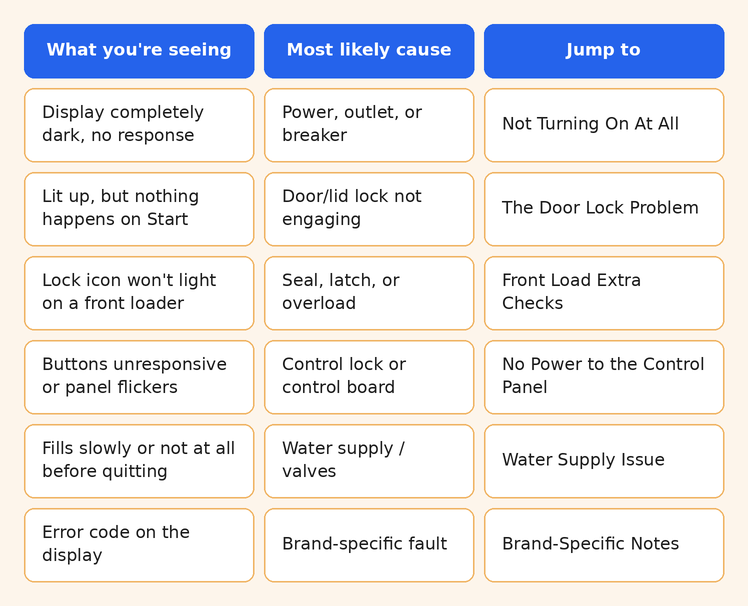
Washing Machine Not Turning On At All
When the display is completely dark and nothing responds, the issue is almost always electrical rather than mechanical. Here's what to check, step by step:
Outlet and power cord. Plug a lamp or phone charger into the same outlet. If it doesn't work, the outlet itself — not the machine — is the problem. Try a different outlet on a separate circuit if one is nearby.
Circuit breaker. Washing machines draw a lot of power, especially during the spin cycle, and can trip a dedicated breaker. Head to your electrical panel and reset any breaker that's in the "off" or middle position. Flip it fully off, then fully on, rather than just nudging it.
GFCI outlet. Many laundry rooms use GFCI-protected outlets, and these trip more easily than standard breakers, especially in damp environments. Press the small reset button on the outlet itself — it's easy to overlook since it's often hidden behind the machine.
Power cord damage. Inspect the cord for fraying, discoloration, burn marks, or looseness at the plug. A damaged cord is a fire hazard and should never be used, even temporarily replace it before running another cycle.
Wall switch. Some laundry setups run the outlet through a wall switch. If someone accidentally flipped it off, the machine will show zero signs of life even though nothing is actually wrong with it.
If a breaker trips repeatedly the moment the machine tries to run, stop resetting it — that's a sign of an electrical fault (often a failing motor or a short) rather than a nuisance trip, and it needs a technician rather than another flip of the switch.
If the unit powers on but a washing machine won't start once you press the start button, the problem likely isn't electrical at all anymore — it's almost certainly a safety interlock, which we'll cover next.
Washer Won't Start a Cycle: The Door Lock Problem
This is the single most common reason a washing machine won't start even though it clearly has power and the display is lit up. Modern washers — front load and many top load models — use a door or lid switch as a safety feature so the drum can't be accessed while spinning. If the machine doesn't sense the door is securely closed, it will refuse to begin a cycle at all, no matter how many times you press start.
How to fix it:
Open the door fully and check for anything wedged in the seal socks, coins, lint buildup, or a stray sock hanging out of the drum are common culprits.
Close the door firmly until you hear or feel a distinct click.
Wipe down the rubber gasket on front loaders dirt, hair, and detergent residue can build up along the edge and prevent a proper seal. Our washer gasket cleaning guide covers this in detail if buildup is heavy.
Push the door shut from the center rather than the edge, since some hinges flex slightly and won't latch if pressure is applied off-center.
If the door still won't latch after cleaning and adjusting, the door switch or plastic striker itself may be worn out, cracked, or misaligned, and will likely need replacing. A worn latch that only sometimes catches is a classic sign the part is on its way out.
Front Load Washer Won't Start: Extra Things to Check
Front load machines have a few quirks that top loaders don't, largely because the door has to form a watertight seal against gravity. If your front load washer won't start, pay special attention to these:
Overloading. Front loaders are especially sensitive to unbalanced loads. Too many heavy items — towels, blankets, comforters bunched on one side can prevent the drum from locking into position and stop the cycle before it begins. Redistributing the load usually clears it;
Detergent overflow. Excess suds, especially from regular detergent used instead of HE (high-efficiency) formula, can trigger a foam-sensing safety feature that pauses the machine before the cycle even starts.
Locked door indicator. Most front loaders show a lit lock icon once the door is properly secured. If it's not lit after closing the door, the cycle won't start no matter which button you press.
Door seal wear. Over years of use, the rubber gasket can lose its shape, especially near the bottom where water and debris collect.
Top Load Washer Won't Start: What's Different
Top load machines rely more heavily on the lid switch and, in many models, a water-level sensor rather than a full pressure lock. If your top load washer won't start:
Confirm the lid is closed and the switch usually a small plastic tab near the hinge isn't broken, stuck, or gummed up with detergent residue.
Check that both water supply valves are fully open, since a partially closed valve can prevent the fill sensor from ever reaching the level needed to allow the cycle to begin.
Listen for a faint clicking sound when you press start; this usually means the lid switch is engaging correctly but a different sensor further down the line is blocking progress.
On older agitator-style machines, check that the lid switch actuator (the small plastic piece that presses the switch when the lid closes) hasn't snapped off, which is a very common failure point after years of use.
Washing Machine Won't Start: No Power to the Control Panel
If the display lights up but buttons don't respond, or the panel flickers unpredictably, this points to the control board or button membrane rather than the outlet itself. Try these steps in order:
Unplug the machine for a full 60 seconds, then plug it back in. This resets the control board and clears minor electronic glitches — it solves more cases than most people expect, especially after a power flicker or storm.
Check for a "control lock" or "child lock" feature. Many models require you to hold a specific button, or two buttons at once, for 3 seconds to unlock the panel. It's frequently triggered by accident when kids or pets brush against the controls, or when a hand lands on the panel while loading laundry.
Look for error codes. A single letter or number on the display, like "dL," "Lo," "E1," or "F5," points to a specific fault and is worth checking against our washer error code guide or searching using your exact model number, since codes vary between brands.
Inspect the button membrane. On older machines, a worn membrane under the buttons can make certain presses register inconsistently. Pressing firmly and directly on the center of a button sometimes reveals this issue.
Check for a stuck relay. If you hear a faint clicking from inside the panel with no response on screen, a stuck relay could be the culprit, and this is a repair best left to a technician.
When It's a Water Supply Issue
A washing machine won't start situation can also stem from restricted water flow, since many models won't begin a cycle if they can't detect incoming water pressure within the first minute or two:
Make sure both hot and cold hoses are connected and the valves are turned fully counter-clockwise to open — a valve that's only partially open is one of the most overlooked causes.
Check hoses for kinks or pinching, especially if the machine was recently moved for cleaning or repair work behind it.
Clean the inlet filters or screens where the hoses connect to the back of the machine — sediment and mineral buildup are common in older homes and can restrict flow enough to stop a cycle from starting.
If you recently had plumbing work done, air trapped in the lines can cause similar symptoms; running a nearby faucet for a minute can help clear it.
When to Call a Technician
If you've worked through every step above and your washing machine won't start, the issue is likely internal: a failing door switch, a faulty control board, a broken timer motor, or a bad motor start capacitor. These repairs involve testing electrical components safely, sometimes with the machine partially disassembled, and aren't something to troubleshoot with the unit plugged in.
At this point, continuing to force the machine to start — unplugging and replugging repeatedly, jiggling the door, or pressing buttons harder — can damage the motor, wear out the door switch further, or create a safety hazard. It's worth having a professional take a look rather than guessing further and risking a bigger repair bill down the line.
Frequently Asked Questions
Why does my washing machine hum but not start?
A humming sound with no drum movement usually points to a seized motor, a failed capacitor, or an object jammed in the drum preventing it from turning. Unplug the machine and avoid running it further until it's inspected.
Can a power surge stop a washing machine from starting?
Yes. A surge can trip the control board into a protective state even if the breaker itself didn't trip. Unplugging for a full minute often resets this.
Is it safe to keep pressing the start button?
Repeatedly pressing start won't damage most machines, but if nothing changes after two or three tries, stop and check the door, power, and water supply instead of continuing to press it.
My washer starts but stops partway through is that the same problem?
Not usually. A machine that begins a cycle and then halts is more often an unbalanced load, a drain issue, or a spin fault see won't spin or won't drain rather than the start-up checks above.
Why won't my washer start right after I moved it?
Moving a machine commonly loosens a hose, kinks a supply line, or unseats the plug. Recheck every connection at the back, make sure the valves are fully open, and confirm the machine is level before running a cycle.
Could my dryer and washer sharing an outlet cause this?
It can. Running both at once on a shared circuit can trip the breaker. If your dryer is also acting up, our dryer repair guide covers overlapping electrical symptoms.

